
(6) Pimensis and Deserti Colony Count
Riya D -
Now that my research on how media type affects D. xinjiangensis’s radiation resistance had been completed, it was time to move on to the next part of my project: seeing how different bacteria, particularly the highly pigmented D. pimensis and the lowly pigmented D. deserti, react under the same conditions of varying media type during UV exposure.
This time, instead of simply saying “yes” or “no” to survival post-UV, I wanted to get a colony count to quantitatively compare the two species. In order to do so, I needed to perform a serial dilution.
I decided to perform 12 dilutions as follows …
1 – 1 in 25
2 – 1 in 50
3 – 1 in 75
4 – 1 in 100
5 – 1 in 125
6 – 1 in 250
7 – 1 in 500
8 – 1 in 1000
9 – 1 in 2000
10 – 1 in 4000
11 – 1 in 8000
12 – 1 in 10,000
Even though I am using both TGY and R2, I only used TGY when performing my dilutions because I figured that if there were countbale colonies on TGY which had more survival, there should also be ones on R2 which had less. And, I did not expose the bacteria to any UV. I simply brought 1 mL of bacteria down to an OD of 0.4, began diluting, then plated 22 microliters into each quadrant.
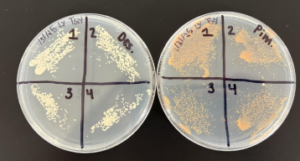
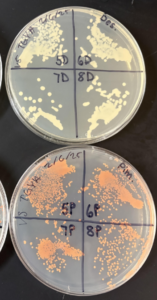
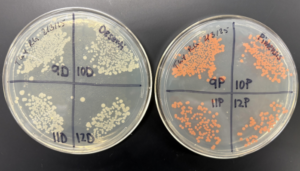
Eventually, as the pictures depict, I was able to find that it was that final dilution – 1 in 10,000 – that allowed me to get countable colonies for both D. pimensis and D. deserti. Using this information, I can begin to create a procedure for this pigmentation experiment!